The short answer
Spice@Five is authentic Punjabi home cooking in Honiton, Devon — not a restaurant, a weekly collection service: order online by Tuesday 10pm, collect Thursday between 5 and 7pm. That model needs one page that loads instantly on a phone at the school gates, answers "what's on this week?", and takes the order. It does not need an e-commerce platform with a basket, a login and a delivery quote engine.
So we built one page. Measured before and after our October optimisation: page weight down from 5.9MB to about 1.5MB, mobile Lighthouse from 83 to 94, largest contentful paint 2.8 seconds, zero layout shift. The menu is updated weekly — sometimes twice — and the owner does not wait on an agency to change a price.
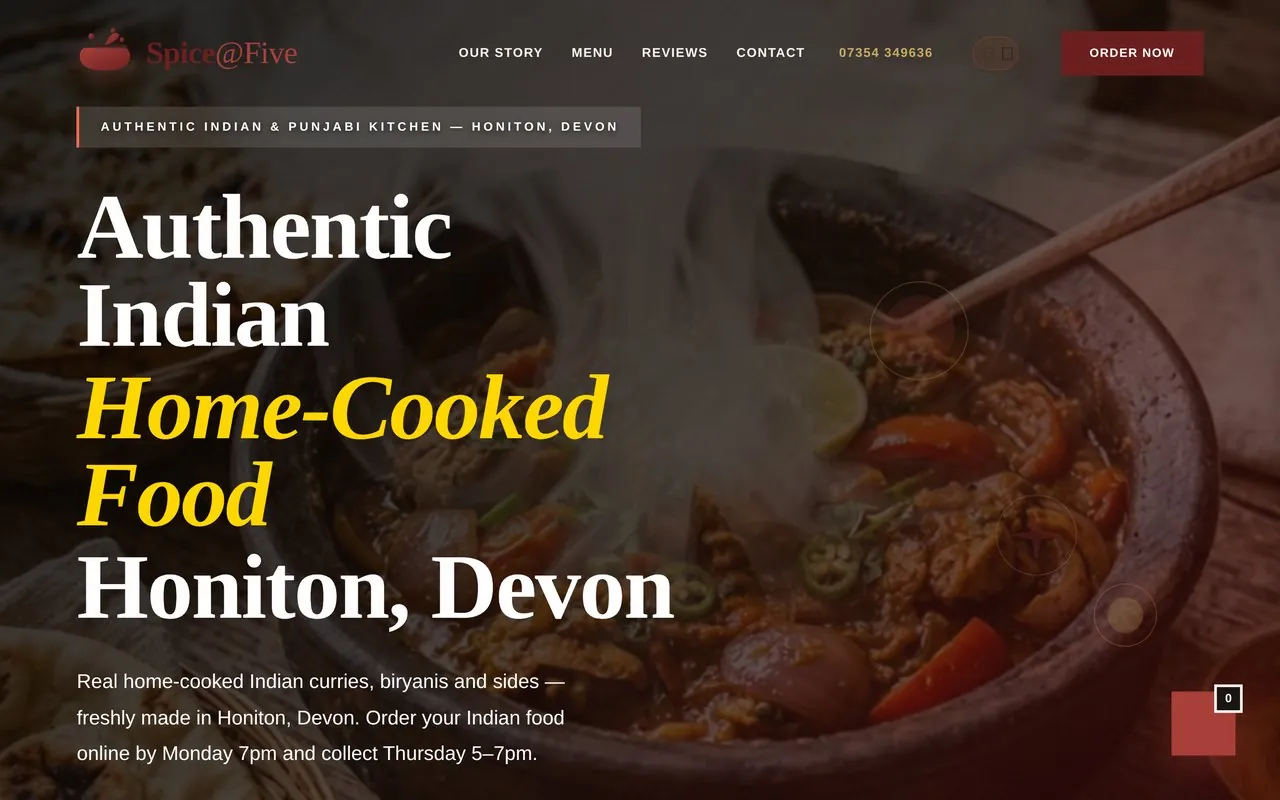
Why one page was the right answer
The temptation with food businesses is a full ordering system. But Spice@Five's customers order once a week from a phone, already knowing they love the food. Every extra step — an account, a basket, a card form — is a chance to lose them. The page answers the three questions a regular has — what's on, when do I order by, when do I collect — and puts the order form directly underneath.
What we built
- One page, hand-coded, with the weekly menu, the order deadline and collection window repeated consistently everywhere — headline, FAQ and the data Google reads.
- An order form that reaches the owner directly, with an automatic confirmation to the customer.
- The kitchen's own credentials, not ours: a 5-star food hygiene rating and certified hygiene training, shown as the business's own achievements.
- Weekly menu updates deployed in minutes, priced honestly on our Foundation plan at £79 a month.
The performance work, in plain numbers
The first version of the page worked but weighed 5.9MB — heavy fonts and images. We rebuilt the asset pipeline: images compressed and correctly sized, fonts trimmed to the glyphs actually used. The result, measured on a throttled mobile connection: 94 for performance, 2.8-second LCP, total blocking time 110ms, layout shift zero. On the connection your customers actually have, the menu appears before they finish putting the phone to their ear.